Sunday, June 21, 2020

Pandemic Baking: Sourdough #18 and #19

We finally felt ready for 80% hydration, since the last three 75% sourdoughs were a complete success.

We have additional data points for today's baking, being the engineers that we are, striving for consistent results.

We did something slightly different with our leaven.
It was our left over starter (about 70g discard), left in the refrigerator for 9 days, about to be thrown out.
We decided to feed it last night once, left it out at room temperature all night, and fed it again this morning at 7:30AM.

It more than doubled its size by 11:30AM!
Super active starter: left out at room temperature and fed twice

Nice active bubbles
Our ambient thermometer and humidity meter has arrived.
Today at mid-day, in our kitchen, we recorded 73.6 deg F and 46% humidity.
It was cloudy in the morning, but now the sun is out. 

At 11:30AM, we prepared to mix the dough.
We used the following measurements:


80% Hydration Sourdough Recipe
453g all-purpose flour (100%)
362g lukewarm water (75% hydration)
136g leaven (30%)
7g salt (1.7%)
Loaf size: 958g
The FDT for sourdough #18 (in large glass mixing bowl) was 81 deg F.
The FDT for sourdough #19 (in medium glass mixing bowl) was 83.3 deg F.

We completed mixing sourdough #18 at 11:36AM, and sourdough #19 at 11:45AM.
Four stretch and fold sessions followed, ending at 1:39PM.

5PM: 75.6 deg F 57% humidity; the house is feeling warm so I turned on the A/C
5:30PM: 75 deg F 50% humidity

Sourdough # 19 during bulk fermentation
Both sourdough #18 and #19 are growing nicely; being in the glass bowls, we can clearly see nice bubbles on the side of the bowls as well as big gas bubbles on the top.

On Monday morning, sourdough #18 (from larger banneton basket) went into the oven at 7:45AM.

Baking schedule for sourdough #18:
7:45AM      in the oven for 21 minutes
                   rotate with lid on for 17 minutes
                   take lid off for 7 minutes
                   leave on bare rack and switch to convection for 3 minutes
                   rotate for 2 minutes
The ambient temperature was 73.4 deg F and 57% humidity

Final weight for sourdough #18: 757g         

Sourdough #18 (80% hydration) weighs in at 757g
Sourdough #18 (80%): 3.5 inches cross section height
Baking schedule for sourdough #19:
3:15PM      audience watching the scoring (aunties and bà on FaceTime) 
                   added 2 ice cubes in the Dutch oven
                   lid on for 21 minutes
                   rotate with lid on for 17 minutes
                   take lid off for 6 minutes
                   on bare rack: light side to the front, dark side to the back
                   switch to convection for 1.5 minutes
                   rotate for 1.5 minutes
                   rotate for 1 minute
The ambient temperature was 74.5 deg F and 49% humidity
Final weight for sourdough #19: 776g

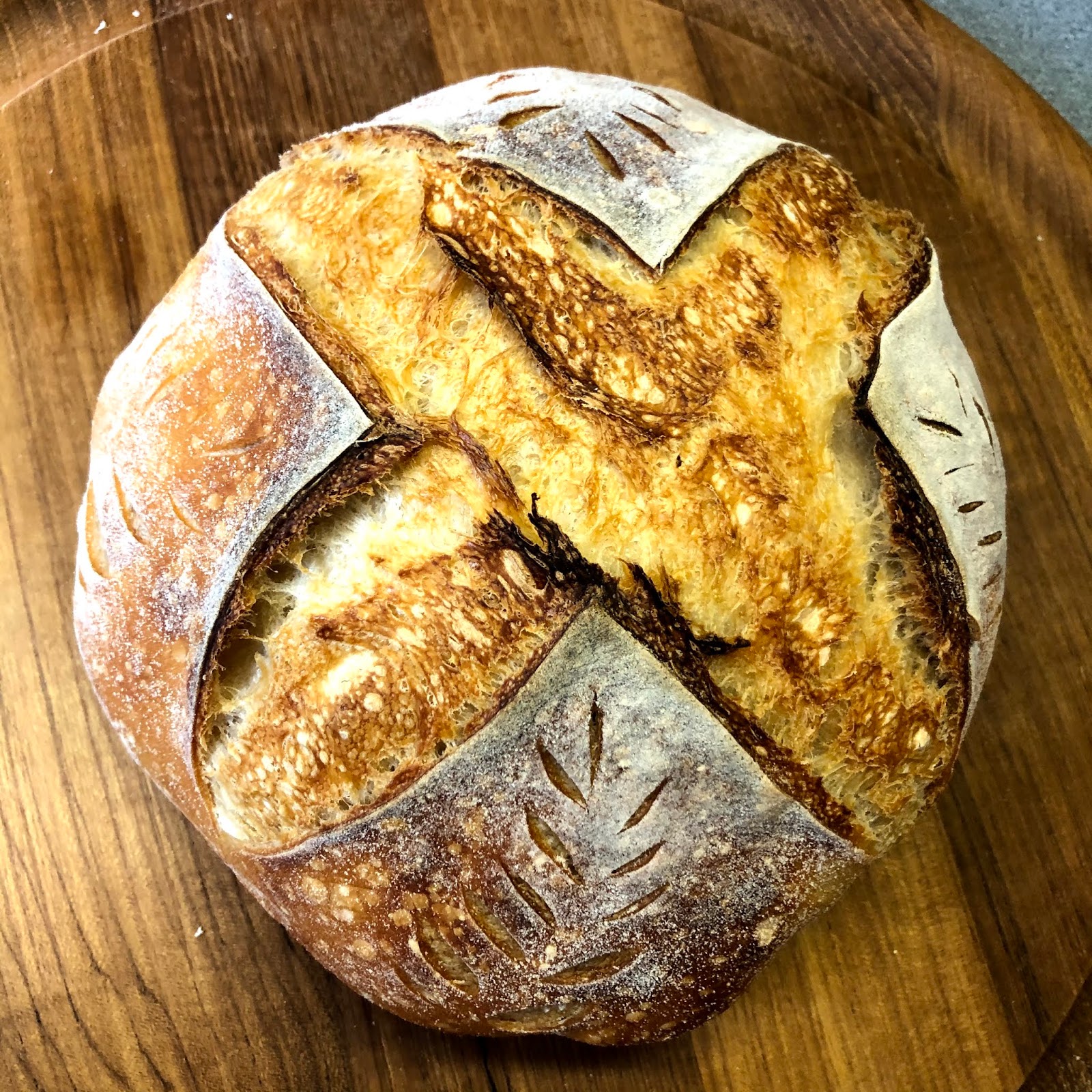
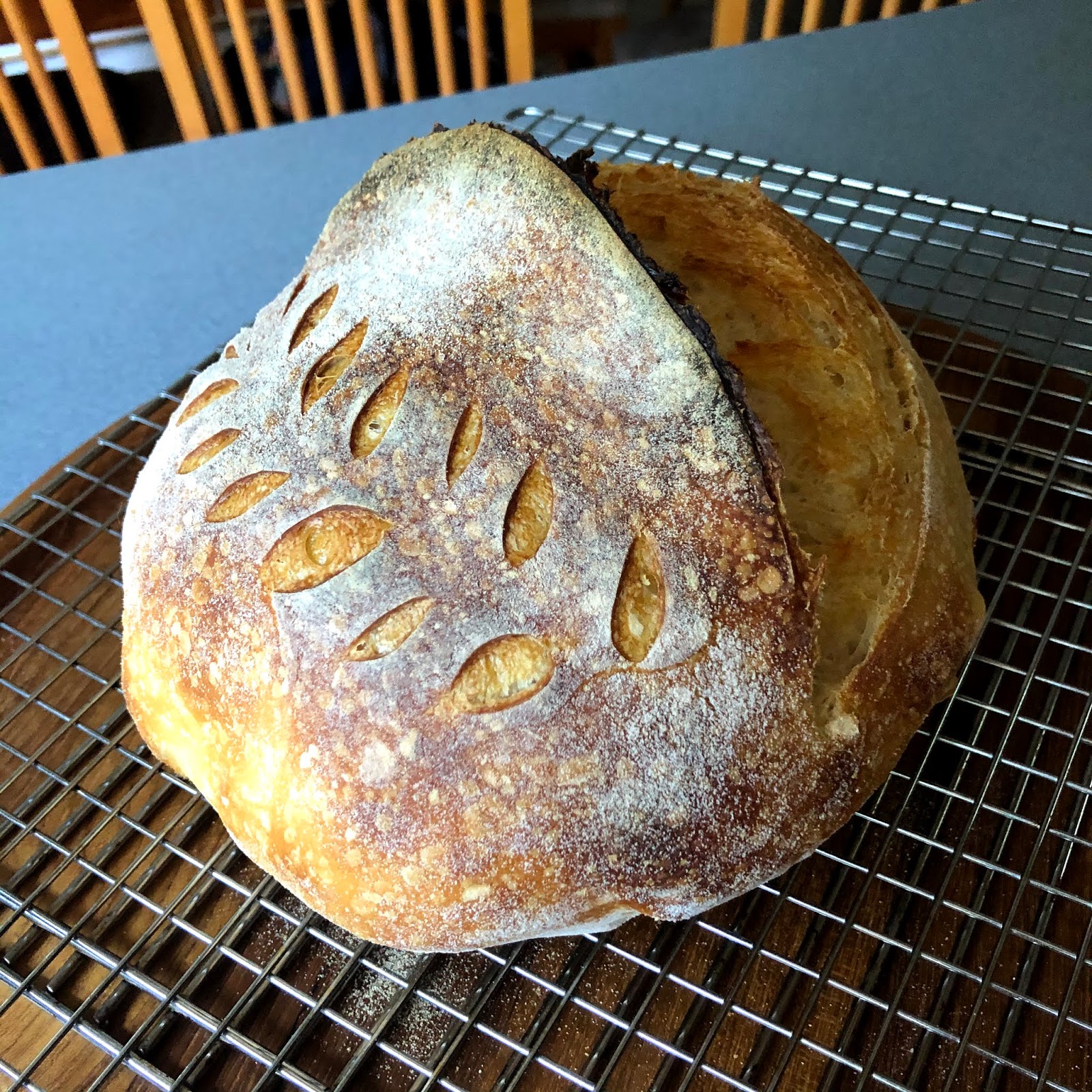
Sourdough #19: Hawaiian Plumeria
Sourdough #19 (80%) with 2 ice cubes in Dutch oven
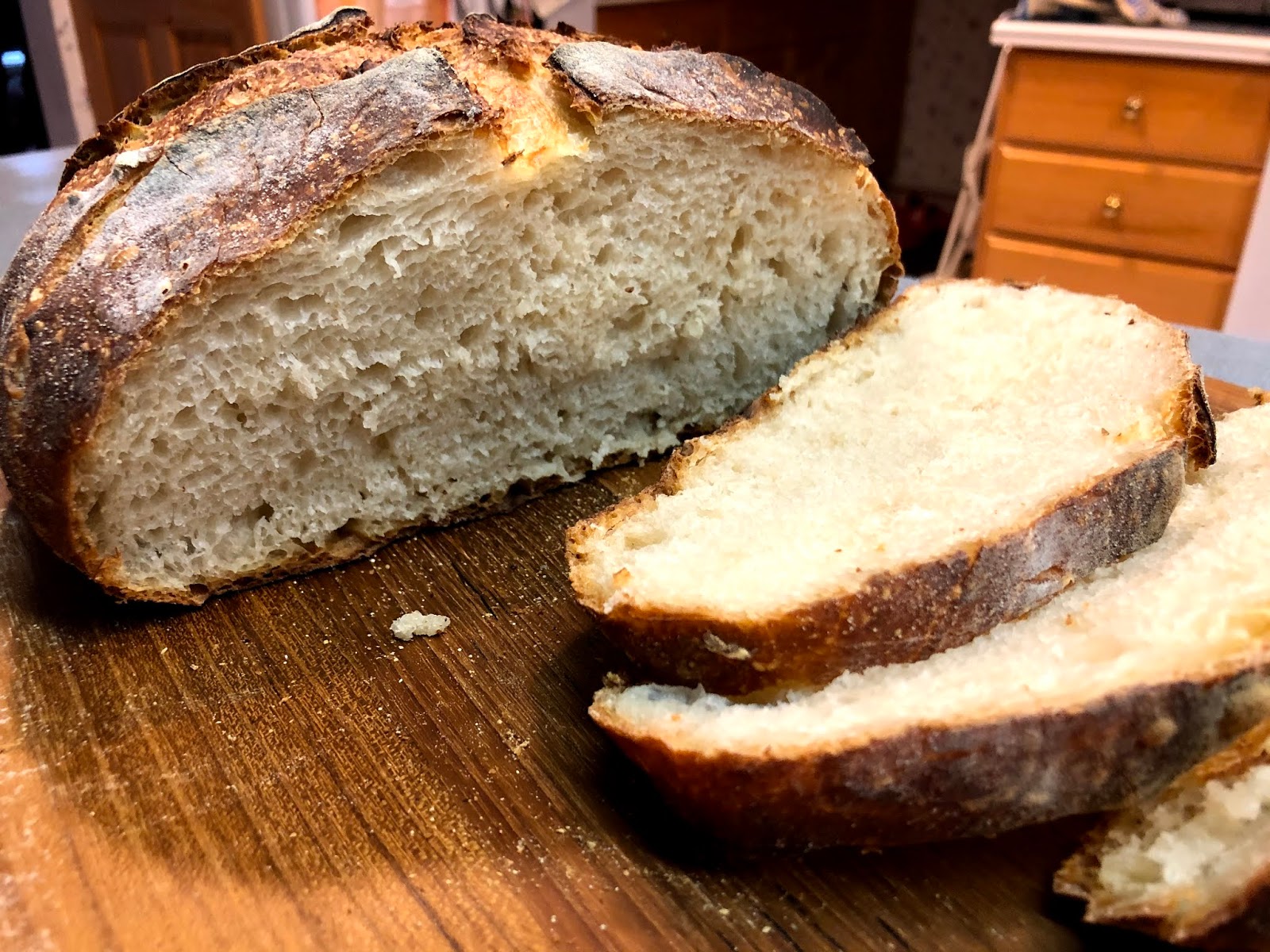
Sourdough #19 (80%) cross section

Saturday, June 20, 2020

Pandemic Baking: Sourdough #15, #16, and #17

Another exciting Friday as we look forward to baking another batch of sourdough breads!
This week, we are making one for us, one for Amy, and one for our neighbor Hua who is moving.
Hua moved into her home across the street from us a month or two before we moved into our home, over 20 years ago.
One of her daughters babysat R&R so we could have date nights.
She has been a great neighbor, and now she is putting her house up on the market, and preparing to move west.

The plan is to perform mixing in parallel, in 3 separate mixing bowls, as opposed to bulk mixing.
We still have some Gold Medal bleached all-purpose flour left, but not enough for all 3 loaves, so we will also be using King Arthur unbleached all-purpose flour to compare the difference.

We also realized that, even though we have kept track of the Baker's Percentage when increasing the hydration level from Aunt Joy's recipe, we did not keep the final dough weight the same. Hence our last sourdough #14 weighed in at 1,033g as opposed to 958g. This would have affected the baking time and explained why we needed to bake longer.

Today, we will fix that mistake, and use the following recipes.
Note that this is still based on Aunt Joy's original recipe, with increased hydration, keeping the final loaf size the same.


70% Hydration Recipe based on Joy's75% Hydration Recipe based on Joy's
475g all-purpose flour (100%) 464g all-purpose flour (100%)
333g lukewarm water (70% hydration) 348g lukewarm water (75% hydration)
143g leaven (30%) 139g leaven (30%)
7g salt (1.5%) 8g salt (1.7%)
Loaf size: 958gLoaf size: 959g

Sourdough #15 has 70% hydration, using Gold Medal bleached all-purpose flour.
Sourdough #16 has 75% hydration, using Gold Medal bleached all-purpose flour.
Sourdough #17 has 75% hydration, using KA unbleached all-purpose flour.

We started the process on Friday morning, for baking on Saturday morning.
We don't have an ambient thermometer and humidity meter yet, but today we measured our dough temperature for the first time.
Dough temperature:
Sourdough #15: 85.6 deg F; sourdough #16: 81 deg F; sourdough #17: 84.4 deg F.
Our FDT (Final Dough Temperature) goal was 78 deg F so we were slightly warmer, which meant it will take a shorter bulk fermentation.

After feeding the starter at 8AM, we began mixing the dough at 12:30PM.
The four stretch and fold sessions ended around 2:30PM.
We pre-shaped at 7:30PM, shaped at 8PM.
Sourdough #15 went into our ceramic bowl.
Sourdough #16 went into our new slightly larger banneton basket.
Sourdough #17 went into our older slightly smaller banneton basket.
All three went into the refrigerator at 8:15PM.
 Starter fed (front) and leaven (back) for three loaves
Sourdough #15 (70%) after pre-shaping: using Gold Medal bleached AP

Sourdough #16 (75%) after pre-shaping: using Gold Medal bleached AP

Sourdough #17 (75%) after pre-shaping: using KA AP flour, this looks the smoothest
On Saturday morning, we pre-heated the oven at 6:00AM
This time, we plan to take the dough directly from the refrigerator to the oven, without letting it warm to room temperature.
This made scoring easier to handle, as the dough was still stiff from the cold.

The first loaf (#15 from the ceramic bowl) went into the oven at 7:12AM.

Sourdough #15 baking time:
1. Preheat to 500 deg F for one hour
2. In oven with lid on for 18 minutes
3. Rotate Dutch oven then wait 11 minutes
4. Remove the lid and wait 5 minutes
5. Put loaf on bare rack and switch to convection at 450 deg F for 4 minutes
6. Check and rotate for last 2 minutes

Sourdough #15 (70% hydration) duplicated #10 beautiful caramel color and blisters
We are very pleased that we are able to reproduce sourdough #10 in coloring with blisters.
This one will be gifted to Hua, our neighbor who will be moving away at the end of the month.
Final post-bake weight for sourdough #15: 783g

After allowing the oven to preheat back to 475 deg F temperature reading (about 30 minutes wait), Sourdough #17 went into the oven at 8:37AM.

Sourdough #17 baking time:
1. Preheat to 500 deg F (it took about half an hour to get it back to 475 deg F reading)
2. In oven with lid on for 18 minutes
3. Rotate Dutch oven then wait 13 minutes (due to higher hydration)
4. Remove the lid (it was a little bit lighter) so wait 7 minutes
5. Put loaf on bare rack and switch to convection at 450 deg F for 3.5 minutes
6. Check and rotate for last 2 minutes

Sourdough #17 (75%) using KA AP flour: a new successful scoring!

Sourdough #17 (75%): awesome coloring!
Sourdough #17 cross section

Another successful loaf this morning! We are so excited to see the beautiful result!
We practiced this new scoring so we can do the next scoring to surprise Amy!
Final post-bake weight for sourdough #17: 812g

After allowing the oven to preheat back to 475 deg F temperature reading (about 40 minutes wait), Sourdough #16 went into the oven at 10:11AM.

Sourdough #16 baking time -- this is a keeper for a 75% hydration loaf!
1. Preheat with Dutch oven at 500 deg F (it took about 40 minutes to get it back to 475 deg F reading)
2. Dough in oven with lid on for 19 minutes
3. Rotate Dutch oven then wait 16 minutes
4. Remove the lid then wait 6 minutes
5. Put loaf on bare rack and switch to convection at 450 deg F for 3.5 minutes
6. Rotate for the last 2 minutes

Sourdough #16 (75%): personalized scoring!
Sourdough #16 cross section

Note: next time try putting the bread with the lettering facing us
Final post-bake weight for sourdough #16: 796g

Sourdough #16 and its rightful owner

Amy came to the house right before her loaf comes out of the oven, and she got a peek of the design.
It was delightful to be able to see her surprised reaction as the oven door opened!
This was Father's Day weekend, and she brought over homemade peanut butter blondies and nutter butter cookies, and a card from her and the boys. We are so lucky to have her in our lives.

And Happy Father's Day!

Saturday, June 13, 2020

Pandemic Baking: Sourdough #13 and #14

These are our notes for the third and fourth loaves in two days.

We started the process of feeding the starter on Friday morning, for baking Saturday morning.

We used up all of the Pillsbury bleached all-purpose flour, and added Gold Medal bleached all-purpose flour.
Note that the Gold Medal bleached AP flour is our last bag of bleached AP flour. During the pandemic flour shortage, we had a hard time finding King Arthur unbleached all-purpose flour. We will be moving to KA unbleached AP flour as soon as we used up this last bag of bleached AP.

We increased the hydration level to 75%.

This time, we decided to leave the dough in the mixing bowl during bulk fermentation, instead of moving the dough to our larger square container.
We had to keep a close eye on the dough to make sure it does not overflow out of the mixing bowl - all was good.

During pre-shaping and shaping, we also were generous in adding a lot of flour onto the working surface and on our hands to keep the dough from sticking.
We felt much better during final shaping as we could see bubbles forming during tension pull.
The same person shaped both doughs, so that we can determine the effect of ice cubes in the Dutch oven without wondering about the difference in shaping success.

Our second banneton basket arrived just in time for our two loaves to proof each in their own banneton basket.
We retarded the dough overnight.

The next morning, we brought both banneton baskets out when we preheated the oven.

This was our baking timeline for sourdough #13:
1. Preheat the oven with the Dutch oven to 500 deg F for about an hour
2. Score from the older banneton basket
3. Put in the oven with lid on and reduce oven setting to 475 deg F
4. After 18 minutes, rotate the Dutch oven 180 degrees
5. After 13 minutes, remove the lid
6. After 6 minutes, move the loaf to bare rack and switch to convection at 450 deg F
7. After 6 minutes, rotate the loaf 180 degrees
8. Bake for an additional 3 minutes

Baking timeline for the follow-on sourdough #14:
9. Put the Dutch oven back into the oven and preheat to 500 deg F
10. Wait until oven thermometer reads 475 deg F
11. Score from the newer banneton basket, this time add rice flour to the top and spread evenly
12. Add four ice cubes into the Dutch oven, and put the dough in with lid on
13. Reduce oven setting to 475 deg F
14. After 18 minutes, rotate the Dutch oven 180 degrees
15. After 13 minutes, remove the lid
16. After 6 minutes, move the loaf to bare rack and switch to convection at 450 deg F
17. After 6 minutes, rotate the loaf 180 degrees
18. After 3 minutes, peek in: still not quite caramelized color
19. Bake for an additional 1 minute 40 seconds

Sourdough #13 on left, #14 (ice cubes method) on right, both 75% hydration

Sourdough #13 on left, #14 (ice cubes method) on right
 Ice cubes definitely did not hinder the rise of sourdough #14.
Sourdough #14 was larger than #13 in every dimension (length and width) and just as tall.
We weighed the loaves after baking, and #14 was slightly heavier than #13 (about 50g heavier) so perhaps this explains the size difference.

Coloring of sourdough #13

Coloring of sourdough #14
We added rice flour to the top and spread evenly right prior to scoring sourdough #14 for that burst of contrast in coloring.
The coloring of sourdough #14 has a very beautiful golden hue, different than that of #13; is this due to the ice cubes? We are not sure.
We also noted that #13 had a lot more blisters than #14.

Twinsie sourdoughs for us and Amy

Sourdough #14: thin crispy crust and open crumb at 75% hydration


Pandemic Baking: Sourdough #11 and #12

This weekend was bulk baking weekend.
The plan was to bake four loaves in two days.
We started to feed the starter Thursday night for the first two loaves, for baking Friday evening.
We fed the starter Friday morning for the next two loaves, for baking Saturday morning.

The following are our notes for the first two loaves.
We were using Pillsbury bleached all-purpose flour, with 70% hydration level.
Of note, the time from fold #2 to fold #3 was 40 minutes, not 30 minutes.

We moved the dough from the mixing bowl into a larger square container with lid for bulk fermentation.

We had a lot of trouble with pre-shaping and shaping, as we were too conservative in using flour on our working surface and our hands, and the dough kept sticking.
We definitely didn't have a nice tension pull during final shaping.

Since our second banneton basket has not yet arrived, we put one in the banneton basket and the second one in a colander with a tea towel to rest.

This was our baking timeline for sourdough #11:
1. Preheat oven with Dutch oven to 500 deg F setting for about an hour
2. Score a simple cross from the colander dough
3. Put dough in Dutch oven with lid on, and reduce setting to 475 deg F
4. After 18 minutes, rotate the Dutch oven 180 degrees
5. After 11 minutes, remove the lid
6. After 5 minutes,  move the loaf onto bare rack and switch to convection baking at 450 deg F
7. After 4 minutes, open the oven to check
8. Bake for one additional minute

Baking timeline for the follow-on sourdough #12:
9. Switch back to baking at 500 deg F and put Dutch oven back in and wait
10. Once oven thermometer reading showed 450 deg F, score the dough from the banneton
11. Add two ice cubes in the Dutch oven with the dough
12. Leave the oven setting at 500 deg F
13. After 18 minutes, rotate the Dutch oven 180 degrees
14. After 11 minutes, remove the lid
15. After 5 minutes, move the loaf onto bare rack and switch to convection baking at 450 deg F
16. After 6 minutes, rotate the loaf 180 degrees
17. Bake for 2 additional minutes


Sourdough #11 on left, #12 on right (both 70% hydration)

Sourdough #12 (ice cube method) had much lower rise

Sourdough #11

Sourdough #12 still has nice crust and open crumb
We were not able to achieve the beautiful caramelized color of sourdough #10, and we were also surprised at how much lower rise sourdough #12 had.

We gave away the better looking of the two, sourdough #11, to Bad Dog and Boss Dog.
We cut up sourdough #12 without waiting for the appropriate cooling period, and noted that the crumb was still a bit wet and was sticking to the knife.

However not as nice looking as what we have been used to, sourdough #12 still tasted excellent, with crispy crust, and a bit more sourdough tangy taste than all our previous loaves.

There were two of us shaping the dough, and we were thinking that the shaping experience was critical in the bread rise in this case, but we were not sure if the ice cubes, instead of helping, also hindered the rise process of sourdough #12.

Therefore, next experiment: ice cube vs no ice cube for our third and fourth loaves of the weekend!

Saturday, June 6, 2020

Pandemic Baking: Sourdough #10

It was a massive sourdough baking weekend.
We are now baking our third loaf of the day.
The first two loaves have been delivered to their recipients, so this one is ours to enjoy.

We made a few more adjustments.

We started the process by feeding the dough on Friday evening for baking on Saturday evening.

We increased the hydration level to 70%.
We were still using Pillsbury bleached all-purpose flour.
The dough was definitely wetter, and stickier, but we managed all right.
It also rose super high, and expanded bigger than all the previous.

When it was time to score, we flipped the dough out of the banneton basket, and it expanded outward.
We scored very quickly, but still, it looked like it was about to deflate fairly quickly.
We rushed to put it in the Dutch oven, and it barely fit.

We had preheated the oven with the Dutch oven for about an hour at 500 deg F.
Once we put the dough in, we reduced the oven setting to 475 deg F.
We baked with the lid on for a total of 29 minutes, where we turned the Dutch oven 180 degrees after 18 minutes.
After 29 minutes, we took the lid off, and baked for another 5 minutes
Then we did something completely different: we removed the Dutch oven, and placed the loaf on the bare rack, and switched to convection.
When we checked 4 minutes later, the loaf was done, and the color was astounding!
Sourdough #10: astounding caramelized top, our first 70% hydration

After a proper cool off, we cut through the loaf, and we could immediately tell we had something special on our hands!
The crust was thin and crispy, both top and bottom.
The crumb was light and airy.
It was perfect in every way.
Sourdough #10: perfect in every way
Hm. But have we truly reached perfection?
So far, every time we tasted a new loaf, we thought it was better than the previous.
It looks like we need to continue on our journey, where the next step will take us to 75% hydration level!

Pandemic Baking: Sourdough #8 and #9

Today we felt bold enough to double the amount of dough preparation and bake two loaves back to back. We even worked the dough on a rainy day!
If they come out well, they are earmarked for our friends Do/Nat and for Amy.

We started the process by feeding the starter on Friday morning for baking on Saturday morning.
We maintained 65% hydration level, same as the successful #7.
We also retarded the dough overnight after shaping so that we would bake first thing in the morning, and deliver the loaves to their recipients during the day.

We made slight adjustments during baking in an attempt to brown the loaves evenly all around:
  • Oven and Dutch oven preheated for one hour at 500 deg F
  • Reduce oven setting to 475 deg F when putting the dough in the Dutch oven
  • Bake bread with lid on for 18 minutes
  • Rotate the Dutch oven 180 degrees
  • Continue to bake with lid on for 11 minutes (for a total of 29 minutes with the lid on)
  • Remove the lid and bake until the coloring is good (about 17 minutes with the lid off)
Sourdough #8 came out beautifully, with a new scoring design
Sourdough #8: nice even coloring, 65% hydration

Sourdough #8: classic cross

Sourdough #9 was just as beautiful
Sourdough #9: beautiful scoring, 65% hydration

Sourdough #9: great oven spring
We have conquered our fear of working the dough on a rainy day!
Whoo hoo!


Monday, June 1, 2020

Pandemic Baking: Sourdough #6 and #7

Today we were full of confidence, so we planned half a day staggered baking of two loaves of sourdough.

Sourdough #6 is earmarked for Amy, who was taking her PT board exam as we worked on the dough for her bread. We wanted to deliver a freshly baked bread to Amy after she completed her exam and relaxed at home. We started the process on Thursday evening, for baking Friday evening.
Sourdough #7 process would start Friday morning and would be completed Saturday morning, in time for our lunch. For this loaf we added a few more experimental steps.

For sourdough #6, we wanted to reproduce the result of sourdough #5, and kept the steps and baker's percentage the same.

Baker's % for Sourdough #6:
60% Hydration
30% starter -- 100% hydration active starter, refreshed (fed)
1.2% salt

We used Pillsbury bleached all-purpose flour.
The goal for Sourdough #6 is to improve the scoring.


Sourdough #6 for Amy, 60% hydration

Amy's Instagram


The top of loaf #6 was more burnt than we expected, a puzzling fact for us since we kept the baking time exactly the same as #5, until we realized that we had used the wrong parchment paper (sorry Amy!).

For sourdough #7, we tested out a new timeline, the one that would require retarding overnight after final shaping.
We made several additional adjustments.
First we added autolyse of the flour and water for 15 minutes before mixing the starter and salt.
We increased the hydration level to 65%.
We slightly modified our baking time: we preheated the oven for one hour at 500 deg F, baked with the lid on for 28 minutes at 475 deg F, then removed the lid and baked at 475 deg F for 5 minutes, when we checked on the coloring of the loaf. We then reduced the temperature to 425 deg F and finished baking for another 5 minutes.

Baker's % for Sourdough #7:
65% Hydration
30% starter -- 100% hydration active starter, refreshed (fed)
1.2% salt

We used Pillsbury bleached all-purpose flour.
Our scoring was the best that we did for this pattern.
We are now ready to try out new patterns on the next loaf!

Sourdough #7: beautiful wheat stalk, 65% hydration

Sourdough #7: great oven spring

Sourdough #7: beautiful ear

Sourdough #7: airy crumb and thin crust


Thursday, May 28, 2020

Pandemic Cooking: Vietnamese Bánh Xèo

Vietnamese Bánh Xèo can be deceiving in that it looks like an omelette, but does not actually contain any egg!

It is more like a crepe made of mainly rice flour, and turmeric which gives it the nice golden color.
It is filled with pork and shrimp, a little bit of onion, and lots of bean sprouts.
It is served with lettuce, mint, cilantro, Vietnamese pickled daikon and carrot, and topped with nước mắm.


Bags of pre-mixed bánh xèo flour can be found at the Asian grocery stores.
The batter needs to be made a minimum of 3 hours in advance, to overnight.

To make batter for 4 crêpes, you need:

  • 6 oz of bánh xèo flour
  • 1 tsp turmeric
  • 1 3/4 cup water
  • 7 oz (or 1/2 can) coconut cream (or coconut milk)
  • 1 scallion

Mix everything except green onion ahead of time and let sit for 3 hours to overnight.
Right before cooking, mince the scallion and add to the batter

For the filling, boil about 3/4 lb of pork belly then cut into strips.
Wash and clean shrimps and bean sprouts and set aside.
Thinly slice a small onion.

Stir fry the onion, pork belly and shrimp in a flat pan, then pour the batter over just like making an omelette.
Add the bean sprouts on top.
Cover and let cook at med-high heat for about 10 minutes until the crêpe becomes crispy.
Fold in half and serve immediately.
Waiting too long will cause the crêpe to no longer be crispy.

Monday, May 25, 2020

Pandemic Baking: Sourdough #5

We can see and taste improvements with every loaf made.

We started the process on Thursday evening, for baking Friday evening.

This time, we felt really good with our stretch and fold technique, so we added a pre-shaping step in our process, followed by a 30-minute bench rest.
After which we performed the final shaping and proofed in a banneton basket for two hours.
The dough rose well, and we used the banneton basket without the liner for added effect.

We preheated the Dutch oven at 500 deg F, baked with the lid on for 30 minutes at 475 deg F, and removed the lid to bake for another 10 minutes.

The scoring of the wheat stalk showed up much better this time, but there is some improvement to be made.

Sourdough #5: 60% hydration


Our Baker's % for this loaf is:
60% Hydration
30% starter -- 100% hydration active starter, refreshed (fed)
1.2% salt

This was baked using Pillsbury bleached all-purpose flour.

This was our timeline used for loaf #4 and #5, and this gave us fresh bread just in time for dinner.
As you can see, bread making takes time, although the time is mostly hands-off.
There are more rest times than activities, as each activity takes no more than 5-10 minutes.
However, you do need to be around the house for the spurts of activity so this is best planned for the day where you can work from home.

Future Work:
  1. As we are having difficulty finding unbleached all-purpose flour during the pandemic, we are interested in finding out the difference in result when using bleached vs unbleached, and the different brands of flour (i.e. the different protein % from the different brands.)
  2. As we build confidence in handling the wet dough, we will be increasing the hydration from the current 60% towards 70-75% hydration to achieve a more open crumb texture and a thinner and crispier crust
  3. As we build confidence in recognizing the correct dough texture at each stage, we will not shy away from making bread on rainy days and will make adjustments to the hydration of the dough as needed
  4. As we build experience, we will be experimenting with mixing bread flour and whole wheat flour in the future.
  5. We will try a new timeline that will get us fresh bread by lunch time

Pandemic Baking: Sourdough Bread #4

We made additional adjustment during our sourdough quest.

On Sourdough bread #4, we achieved the hydration level per Aunt Joy's recipe, as we became more confident with our wet dough handling skills.
We also reduced our baking time to take into account the fact that we pre-heat our Dutch Oven whereas Aunt Joy does not preheat hers.

We started the process on Thursday evening, for baking Friday evening.

The result is a fabulous loaf of sourdough bread, perfect in (almost) every way! Beautiful crispy crust, and a light and chewy crumb! The only improvement would be the scoring of the bread: we did the decorative scoring without providing an expansion scoring, so the wheat stalk did not come out the way we imagined.

Sourdough #4: 60% hydration


This was baked using 411g of White Lilly bleached all-purpose flour and 89g of King Arthur unbleached all-purpose flour.

Our Baker's % for this loaf was:
60% Hydration
30% starter -- 100% hydration active starter, refreshed (fed)
1.2% salt

We have now increased our hydration back to 60% per Aunt Joy's original recipe.
We preheated the Dutch oven to 500 deg F, then reduced to 475 deg F and baked with the lid on for 30 minutes, and took the lid off to bake for another 10 minutes.
We were happy with this baking time.